- Content Production
7 July 2026
Why the Influencer Certificate is a true game-changer
As part of our whitepaper ‘The vision of 27 marketers and content creators for 2026’, we asked Patrick Marck, Director...
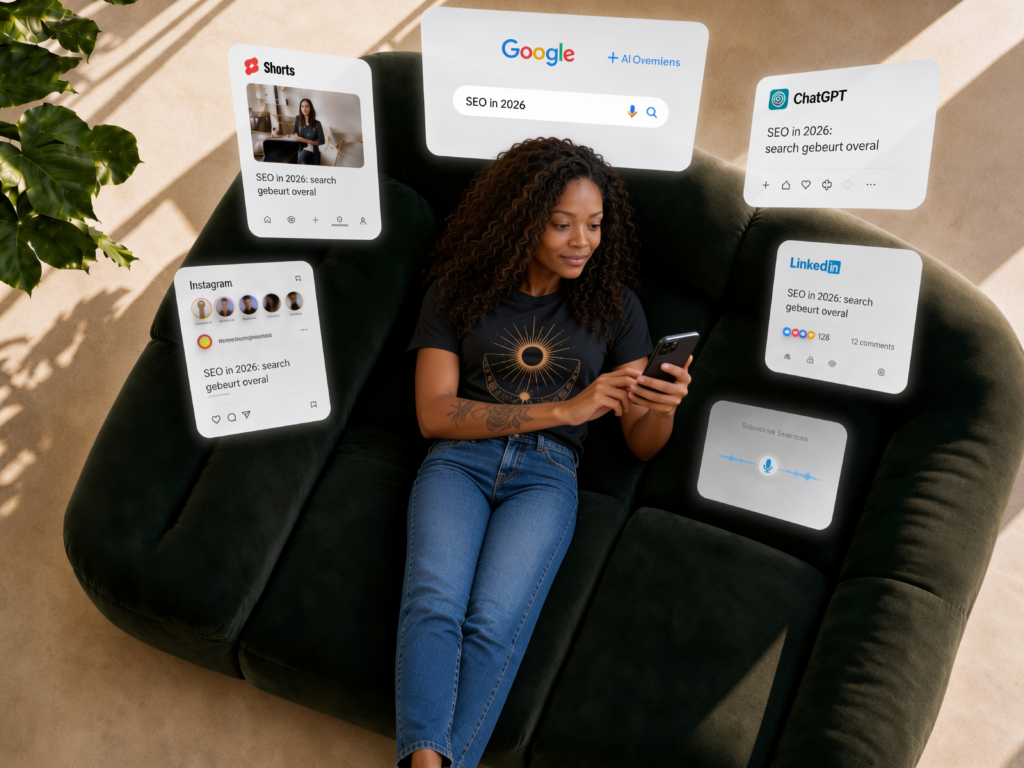
As part of our whitepaper ‘The vision of 27 marketers and content creators for 2026’, we asked freelance SEO & automation builder Hans van Gent for his vision for 2026 and two practical tips he would give to readers. You can read his response below.

Who is Hans van Gent?
Freelance SEO & automation builder Hans helps brands grow by treating search as a system, not a channel. He blends SEO, content, and automation to find the highest-leverage moves, then builds simple workflows that teams can run every week. His work spans global names like Nestlé through to local printing shops and SaaS startups, which gives him a practical view on what scales and what still needs human judgment.
The shift has been underway for years, but most brands still treat SEO as “content for the website.” In 2026, that mindset breaks. People start their journey where it makes the most sense for the job they want to do. If they want to buy, they search on Amazon directly. If they want inspiration, they go to Pinterest or TikTok. If they want how-to depth, they try YouTube or Reddit. If they want a quick answer, they ask an AI assistant.
Discovery doesn’t start in one place, so your content cannot live in one place either. The play is to design reusable content blocks that can be adapted to each surface, keep the same claims and proofs wherever they appear, and guide people back to a clear next step with your brand.
AI helps scale this distribution and adaptation, but humans still set the strategy, voice, and evidence. That is how you ship more, maintain high quality, and show up consistently where your buyers actually search.
Winning teams stop publishing a random collection of posts and start demonstrating complete coverage of a problem space. Think in maps, not posts. You cover the full cluster with explainers, comparisons, workflows, data, and proof. The by-product is brand. When you become the reference across channels, you do not chase rankings. You earn them.
AI speeds research, briefs, outlines, and first drafts, but humans provide strategy, voice, and proof. The scalable model is human-in-the-loop: prompts and guardrails up front, expert editing and evidence on the back end. That is how you produce more without sounding like everyone else.
Attribution gets harder, so measurement must get smarter. As journeys hop across channels and assistant answers, last-click becomes even less useful. Expect more untracked influence and more brand-led discovery. Share of search, assisted conversions, and directional lift from cohorts start to matter more than single-touch dashboards.
Treat the results page as a blended canvas of organic, paid, and AI answers. The opportunity is not just position 1. It is coverage across features, formats, and moments, then using overlap and gap analysis to decide where to invest next.
Common pitfall to avoid: “Optimising for AI” by pumping out generic content. Assistants reward authority and evidence, not volume. Publish original insight, data, and named authorship, then build the signals that LLMs use to trust you. Guest posting, smart link building, and digital PR create the external proof that you are the source on your USP. When the wider web repeatedly mentions your brand in context with those strengths, LLMs and search systems cannot ignore you.
Use AI to accelerate the parts of content work that are slow, while protecting craft where it matters. Start with a style guide, prompt library, and acceptance checklist. Let AI cluster keywords, generate briefs, draft outlines, suggest variants, and highlight gaps. Keep humans on headlines, narrative, examples, and proof. Ship with evidence on every page. In 4 to 8 weeks, you will publish more consistently and keep your voice. Measure success with throughput per writer, edit time per draft, and quality scores from a simple rubric.
Interview 5 to 10 customers about their jobs, pains, triggers, and success criteria. Translate each job into a cluster: problem, solution, alternatives, setup, pitfalls, and proof. Prioritize clusters by business impact and effort. Build a publishing roadmap that covers the whole journey across channels. Use a “SERP as one” view to spot overlap and gaps between organic, paid, and assistant answers. Tools that unify these views, like SERP Smoothie, help you decide where a post, comparison, how-to, or product page will attract attention fastest.
Would you like to discover the other 26 marketers’ and content creators’ visions for 2026? Download the whitepaper here.


