- Content Production
10 July 2026
From SEO to GEO: marketing in the AI-first era
As part of our whitepaper ‘The vision of 27 marketers and content creators for 2026’, we asked search marketeer Pieter...
As part of our whitepaper ‘The vision of 27 marketers and content creators for 2026’, we asked Karl Gilis, co-founder of AGConsult, for his vision for 2026 and two practical tips he would give to readers. You can read his response below.

Who is Karl Gilis?
Karl is the co-founder of AGConsult, a UX agency specialised in innovation through user research and controlled experiments. At AGConsult Karl helps brands such as Carglass, Nespresso, Collect&Go and Foodbag to become truly customer-driven. Companies such as Microsoft, Teamleader and Colruyt come to AGConsult to train and coach their teams to become better at UX and experimentation. Karl is a lecturer at several universities and university colleges. He’s also a top rated keynote speaker who has spoken at +150 conferences in more than 40 countries.
Creating personas is often a balancing act between storytelling and data. For years, I hated them. Most personas I encountered were nothing more than fictional characters filled with made-up hobbies and details like “Lisa, 34, loves yoga and has a rescue poodle named Oliver” or “Peter, 29, windsurfs on weekends and likes white sneakers.” These stereotypes usually came out of brainstorming sessions rather than user research.
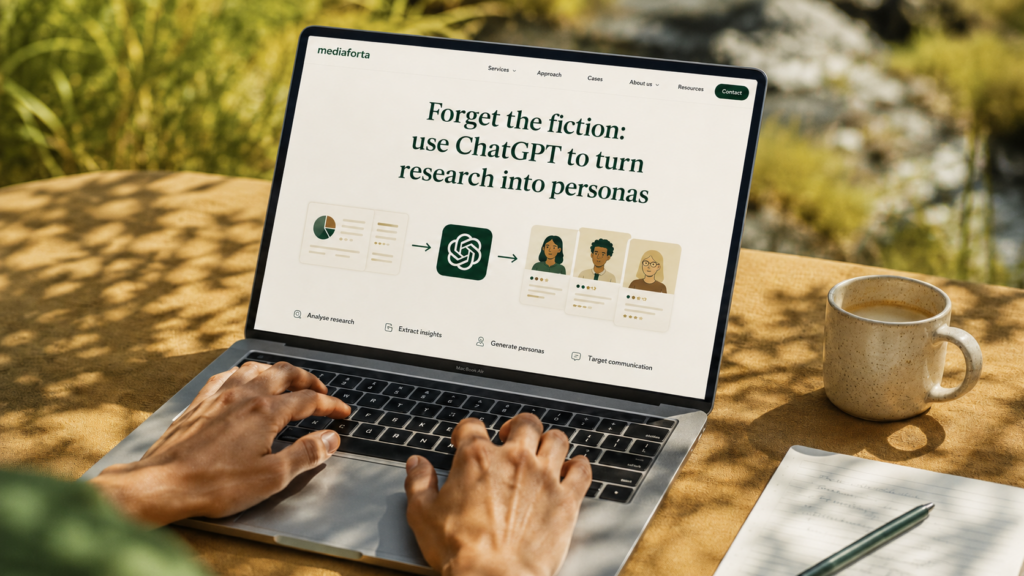
But it doesn’t have to be that way. With ChatGPT (or another LLM of your choosing) and real data, personas can finally become what they were meant to be: usable tools grounded in insight, not fluff.
The magic is not in telling ChatGPT what kind of personas you want. It is in letting it discover them based on data you feed it.
ChatGPT is only as good as the data you give it. If you want it to distill personas that are real representatives of your customer base, you need to feed it real data. Use actual research reports, not only data dumps. Insights instead of isolated numbers.
And it should go without saying: that research ideally is your own, not something generic you found in a report about “Gen Z trends for sector X” or “Marketing insights 2026 for sector Y.” If the data doesn’t come directly from your customers or your users, you’re just guessing. Or worse, you’ll get personas that don’t actually match your audience. Ideally, it’s also fresh research. Data has a shelf life: how people thought about something and what users wanted five years ago might not be what they want now. A persona based on outdated insights can lead you in the wrong direction, no matter how polished it looks.
Start with real research, like:
Feed all this to ChatGPT with the right framing and it will start clustering behavior, motivations, and expectations. For example, in a recent project for a university, ChatGPT took reports summarizing web survey responses and identified five persona. Not based on made-up traits, but on what real users were trying to achieve: searching by interest area, needing info to share with parents, looking for flexible study formats… No invented details. Just real user patterns brought together in a format that designers, marketers, and content teams could act on.
ChatGPT will not replace your strategic thinking, but it can accelerate it. Especially when you give it context-rich, structured inputs.
AI is great at pattern finding. Feed it with real research and you will get personas grounded in user evidence, not imagination.
Not biasing your LLM prompt is vital.
Do not try to shape the output by asking for specific persona data. Avoid specifying how many personas you want or asking for things like age, gender, or region.
Those constraints will bias the outcome and turn your persona exercise into fiction. That’s because if you ask an LLM for something, it will want to please you. So it will give it you, even though it might not be true. Avoid this by keeping your prompt clean and letting the LLM focus on the real data you feed it.
Instead, use a prompt like:
“I’m sharing research about website visitors. Please extract personas based on content needs and behavior. Use archetypes if needed and focus on motivations and goals.”
This sets ChatGPT up to do the heavy lifting by synthesizing, clustering and translating raw data into actionable personas.
Once you’ve built your personas using real research, you can go a step further and turn them into Custom GPTs, AI tools that think and write like your users. You’ve got a corporate style guide you need to stick to? No worries. You can add that to the Custom GPT as well.
For example, imagine one of your persona’s is “Future Student”: a young person fresh out of high school, exploring study options.
You can create and train a Custom GPT with this persona’s goals and common questions. Use it to generate landing page text that feels intuitive to them. Or simulate how they might react to parts of your site. It can even help evaluate content: would this language work for someone who’s never been enrolled in higher education before?
Would you like to discover the other 26 marketers’ and content creators’ visions for 2026? Download the whitepaper here.


