- Content Production
10 July 2026
From SEO to GEO: marketing in the AI-first era
As part of our whitepaper ‘The vision of 27 marketers and content creators for 2026’, we asked search marketeer Pieter...
Artificial intelligence will continue to shape digital marketing in 2026. That much is certain. But AI alone does not explain how brands build visibility, authority or sustainable growth. AI has started to move beyond both the experimental and “wow” factor phase – it has become infrastructure. It now underpins how content is created, how information is discovered and how decisions are influenced. As this infrastructure stabilises, a more fundamental factor is moving front and centre again: authenticity.
The past year was defined by experimentation. Marketers tested prompts, explored generative tools and automated large parts of their content workflows. The efficiency gains were real, but so were the side effects.
AI dramatically lowered the barrier to content creation. We’ve seen the result – saturation. Search results, social feeds, and AI-generated answers are now filled with content that is technically correct and well-structured, yet increasingly interchangeable. The content appears to be accurate, but it rarely feels genuine.
Both users and algorithms are adapting. Audiences are scrolling through pages faster and have become more selective with their trust. Search engines and language models are filtering more aggressively for cues that indicate depth and credibility rather than surface-level optimisation.
Authenticity has always mattered, but in 2026, it will become a requirement rather than a differentiator.
Today, search engines and large language models evaluate content through context. They look for answers to three fundamental questions:
Content that doesn’t straightforwardly address these questions clearly will continue to be around, but it will receive less visibility, as well as being less reusable in AI-driven environments.
This is where many brands struggle – they optimise for output and efficiency, not for credibility. They are publishing more, but saying less.
This shift doesn’t imply that AI should be avoided. The opposite is true.
The strongest brands in 2026 will be those that use AI intentionally, as a multiplier of real expertise rather than a substitute for it. AI excels at processing information, structuring content and scaling distribution. What it cannot do is replace experience, judgement or accountability.
In practice, AI works best when it is used to:
Without a foundation of expertise, these advantages evaporate. AI can amplify insights, but it cannot invent them.
As search becomes more generative, visibility is moving beyond rankings and clicks. Brands are increasingly appearing through mentions, summaries and citations generated by AI systems.
In this context, authenticity is evolving into an optimisation layer of its own. Content that is clearly authored, grounded in experience and consistent in its perspective is more likely to be referenced by language models. Over time, this creates authority that is difficult to replicate artificially.
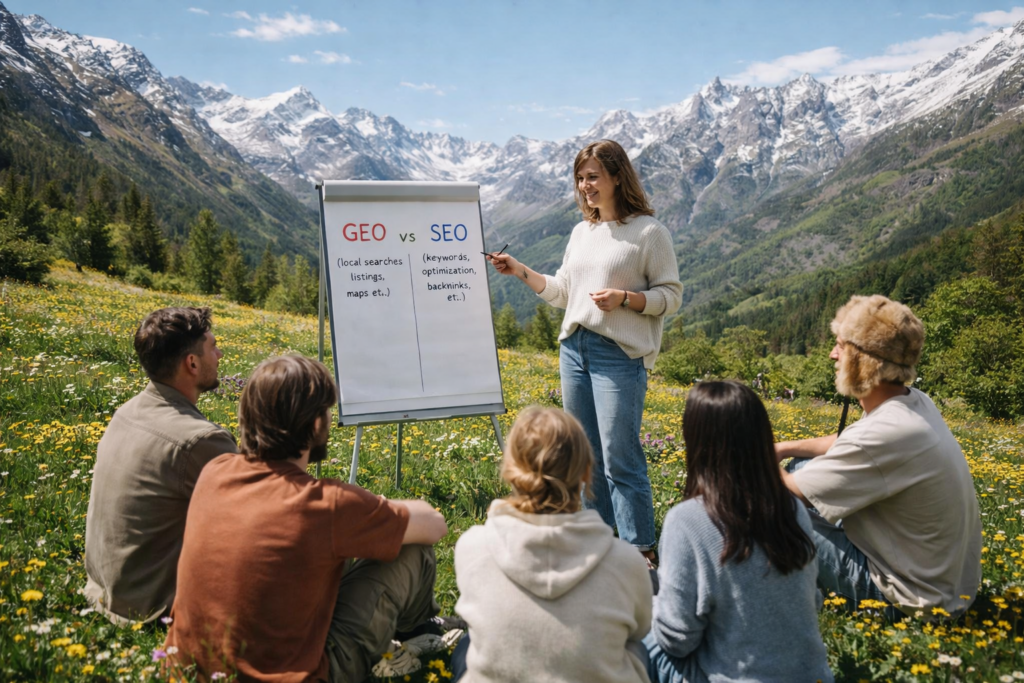
SEO and generative engine optimisation (GEO) are converging around the same principle: being recognised as a reliable source matters more than being the loudest voice.
For most organisations, the implications of these developments are likely to be clear but uncomfortable. Visibility in AI-driven search cannot be manufactured through volume alone. It requires commitment to expertise and a willingness to put real people at the centre of a brand’s content.
That typically means:
These choices rarely optimise for short-term KPIs, but they align strongly with how both humans and AI systems evaluate trust.
The most important change we will see in 2026 is not technological – it is philosophical.
AI will continue to accelerate content production, but it will also continue to raise the bar for credibility. As a result, authenticity will become a foundational quality. It will underpin SEO, GEO and brand authority in a way that no optimisation trick could.
Algorithms can generate language, but they cannot generate trust.
And in 2026, trust is what determines what content is surfaced, cited and remembered.
In SEO and GEO, authenticity refers to content that is clearly authored, grounded in real expertise and consistent across channels. It signals trust to both search engines and large language models.
AI-driven search systems prioritise credible sources. Content that mentions its creator, why they are qualified and what attests to their expertise is more likely to be cited, summarised and reused in AI-generated answers.
LLMs assess trust through elements such as named authorship, demonstrated experience, topical consistency, external references and alignment between brand messaging and expert voices.
AI-generated content is not inherently harmful. However, content created without original insight, ownership or expertise is less likely to perform well in AI-driven search environments.


